HD Video Downloader & Player
- 4.2
- Rating
- 1.00M
- Installs
- Free
- Price

 Analysis by App-foxy
I approached HD Video Downloader & Player as a practical tool for the moment when a video needs to move from “I found something useful” to “I can watch it reliably later.” It sits in the video players and editors category, but its real value is more focused than a full creative suite: it is designed around downloading video or music and playing it offline in high definition. That makes it interesting for people who manage reference material, collect clips for personal viewing, or need a straightforward way to keep media available when a connection is unreliable.
My first impression is that this is not an app I would choose to build a polished video from start to finish. I would choose it earlier in the process, when I am gathering material or preparing a small offline library. That distinction matters. The store summary presents it as a fast downloader and music download tool with offline playback, while the short description simply calls it an HD video player. In everyday use, I see it as a compact media utility rather than a replacement for a timeline editor, publishing platform, or professional asset manager.
From a creative idea to a usable offline library
A useful creative workflow often begins before editing. I might be planning a presentation, studying visual references, preparing a travel playlist, or collecting material to review away from home. In those situations, the first problem is not trimming clips or adding effects. It is making sure the media is available when I actually need it. This is where the app’s combination of downloading and playback makes sense.
You May Also Like

 Blood Strike: 2.5 Anniversary
Blood Strike’s Loadouts Turn Every Drop Into a Tactical Gamble
A close look at Blood Strike’s custom loadouts: how fast access to signature weapons reshapes its battle royale rhythm, rewards preparation, and narrows the gap between fights.

 Pandora - Music & Podcasts
Pandora’s Music Is Easy to Start, but Harder to Recover
Pandora’s strength is its low-effort path from a seed to a station. Its weak spot is how much confidence it asks you to place in connection, setup, and quiet recovery.

 8 Ball Pool
 Is Built on Rivalries, Rematches, and Routine
A close look at the rivalries, rematches, shared routines, and unanswered safety questions that turn a quick pool match into a persistent mobile community.

 Samsung Music
’s Quiet Strength Is Playing What You Already Own
Its reach comes less from spectacle than from dependable access to a personal library. That simplicity is both the app’s strongest retention engine and its ceiling.

 AccuWeather: Weather Radar
AccuWeather Review: A Quick, Clear Forecast for Everyday Decisions
For everyday plans, the best forecast is the one you can understand quickly. AccuWeather makes rain timing, radar, and local conditions easy to act on, with a few trade-offs.

 Hill Climb Racing
Why Hill Climb Racing Still Turns Crashes Into One More Run
A tiny car, a bumpy hill and one more upgrade: Hill Climb Racing keeps resurfacing because its simple chaos makes every near-miss feel personal.
More From Our News Desk



I like the idea of separating discovery from consumption. Instead of repeatedly searching for the same video whenever I want to revisit it, I can organize my viewing around downloaded material. That is especially practical for a commute, a location with inconsistent reception, or a work session where I do not want playback to depend on a live connection. The app’s offline focus gives it a clearer purpose than a basic player that only opens files already stored on the phone.
There is also a useful distinction between a reference clip and a finished deliverable. If I am making a short social video, I may need to inspect pacing, framing, spoken instructions, or background music before deciding what belongs in my own project. A downloader and player can support that preparation stage without pretending to replace the editing application used later.
One practical habit I would recommend is creating a simple naming routine immediately after downloading. Use names that describe the subject and intended use rather than leaving a collection of indistinguishable files. For example, a reference about lighting, a tutorial for a product demonstration, and a music track for personal listening should be easy to recognize at a glance. This is not a flashy feature, but it prevents the offline library from becoming a second search problem.
Who benefits most from the starting workflow
The app is a good fit for someone who wants fewer steps between finding media and watching it later. Students can use it for study material, travelers can prepare entertainment before leaving a stable connection, and creators can gather visual references before opening an editor. It may also suit people who simply want one place for downloaded video and music instead of switching between a browser, a file manager, and a separate player.
I would be more cautious if your starting point is professional asset collection. A serious production workflow usually needs searchable tags, project folders, licensing notes, version history, and dependable collaboration. Nothing about this app’s positioning suggests that it is built to replace those systems. For a small personal collection, simplicity is helpful; for a large production archive, it can become limiting.
The app is free, which lowers the barrier to trying it. It is rated for Everyone, so its presentation is aimed at a broad audience rather than a specialist editing market. LKY Studio is the developer, and the app has passed the one-million-install mark with an average rating of 4.2 from around 861 ratings. Those figures suggest that it has found a substantial audience, although popularity alone does not tell me whether its workflow matches my own habits.
How the making process works in real use
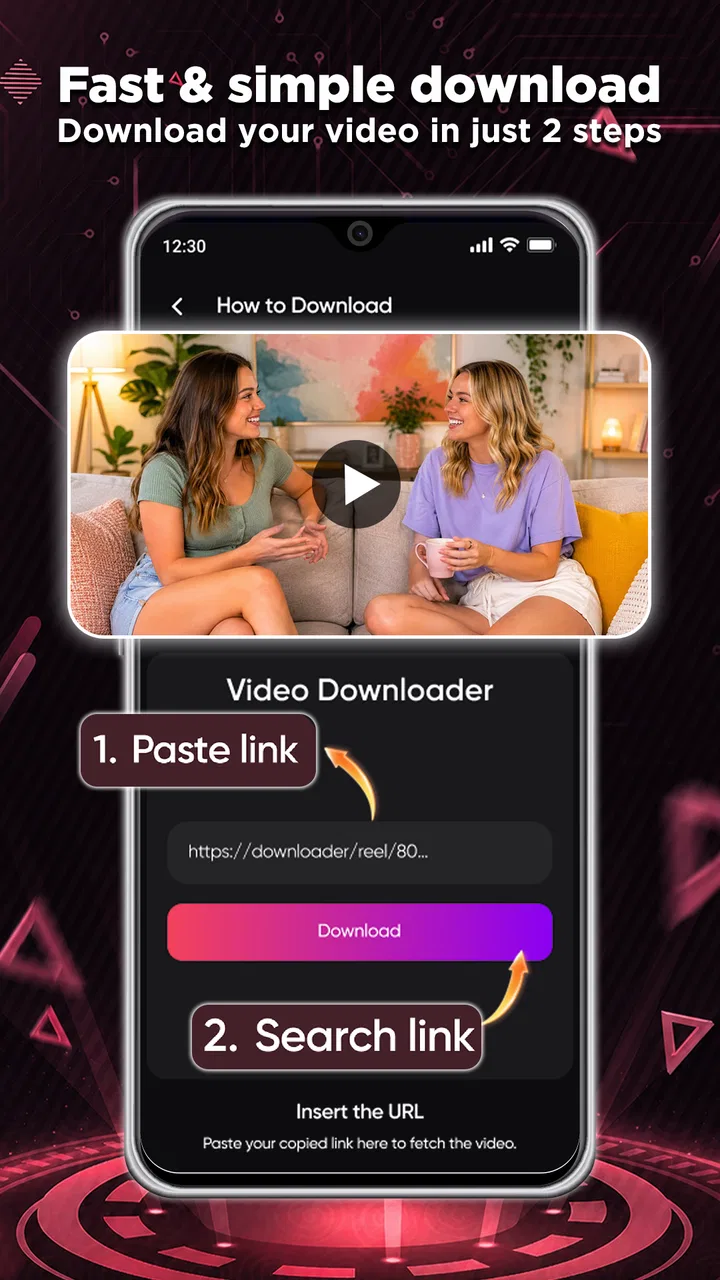
Once I have decided what I want to keep, the central workflow is simple in concept: download the media, locate it in the app, and play it offline. That simplicity is the main strength. I do not have to open a full editing environment just to review a clip, and I do not need to keep returning to an online source for every replay.
For a creator, the most useful way to think about this process is as preparation. I might download a tutorial before recording my own demonstration, save a reference video before comparing composition choices, or keep a music file nearby while planning the rhythm of a montage. The app helps make those references available, but I would still do the actual cutting, mixing, captions, and visual design in a dedicated editor.
Playback quality matters here because a reference is only useful if I can inspect it comfortably. The HD player positioning makes sense when I need to study details such as text on screen, a presenter’s hand movement, or the timing of a transition. At the same time, “high definition” does not automatically mean every file will look perfect on every device. The experience will still depend on the source media, the phone’s display, and available storage.
A less obvious trade-off is storage discipline. Offline video is convenient precisely because it occupies local space. I would avoid downloading everything that looks interesting and instead keep only material connected to a current task. After finishing a project or study session, I would review the library and remove files that no longer earn their space. This keeps the app useful as a working shelf rather than turning it into an unmanageable archive.
A realistic everyday scenario
Imagine I am preparing a short cooking video for a small personal channel. Before filming, I want to study a few examples of overhead framing and listen to a music track while sketching the sequence. I download the references, watch them offline while planning, and note which shots I want to recreate in my own way. When I move into production, I use a separate camera and editing app for recording and assembly. The downloader and player has done its job by making the research material easy to revisit without interrupting the creative session.
Another scenario is a long train journey. I may want to review instructional videos, keep music available, and watch a few saved clips without relying on a stable signal. In that case, the app’s value is not creative output in the narrow sense; it is continuity. It lets preparation happen before the journey, when I have a connection, and consumption happen later, when I may not.
For music, I would treat the app as a convenient offline listening tool rather than a complete music-management system. If I need playlists with advanced recommendations, synchronized libraries, or a service’s full catalog, a dedicated music platform will probably be better. If I simply want downloaded audio or video in one practical place, the narrower approach can be enough.
Where the workflow needs patience
Downloading is not the same as editing, and that boundary can surprise users who arrive from the “Video Players & Editors” category expecting creative controls. I would not install this expecting a timeline, transitions, color correction, subtitles, voice-over recording, or a direct publishing pipeline. The app’s role is closer to acquisition and playback than transformation.
There is also a responsibility attached to downloading media. I would use the tool only with content I am allowed to save and play offline. Keeping a file on a phone does not automatically grant permission to redistribute it, include it in a commercial project, or upload it somewhere else. For creators, this is particularly important: a downloaded reference can guide decisions, but it should not quietly become an unlicensed asset in the final export.
Another point is the difference between offline access and backup. I would not treat the app as my only copy of important creative material. A phone can be lost, reset, or filled with other files. If a clip is genuinely important to a project, I would keep a separate, clearly organized copy in the storage system I already trust. This app is useful for access and viewing; it should not be confused with a full backup strategy.
Iteration: reviewing material before committing to an edit
The strongest creative use I found is iterative review. Before I commit to a shot list, soundtrack, or visual direction, I can watch references repeatedly and compare them with the idea in my head. Offline playback makes that review less fragile. I can pause, replay, and return to the same material without rebuilding the session each time.
I would use this stage to make small decisions: Is the introduction too slow? Does the framing leave room for captions? Does the music suit the intended mood? Does a tutorial explain a technique clearly enough to follow? The app does not answer those questions for me, but it removes some friction from asking them.
A helpful method is to keep downloads grouped by the decision they support. One group might be references for camera angles, another for pacing, and another for sound. Even without advanced production features, this approach turns a general downloader into a lightweight pre-production board. It also makes it easier to delete material once a direction has been rejected.
The limitation is that playback alone may not be enough for detailed comparison. If I need frame-accurate notes, side-by-side viewing, annotations, waveform inspection, or direct clip extraction into an editing timeline, I would move to a more specialized tool. The app is efficient for watching and revisiting, but it is not designed to carry every stage of an iterative review.
That is where the usual alternatives divide into two groups. A standard streaming app is often better for discovery, recommendations, and keeping content inside its own service. A file player is often better for opening media I already possess. A full editor is better for turning selected material into a finished sequence. This app occupies the middle ground: it combines downloading with local playback, which is convenient when both actions belong to the same small workflow.
Tips for keeping iteration useful
Download only the clips connected to a current decision, then clear out rejected references instead of allowing them to accumulate.
Watch important material once with sound and once with the screen as the main focus; this helps separate pacing problems from audio problems before editing begins.
Keep reference media distinct from files intended for final delivery, because a convenient download folder can otherwise be mistaken for a production-ready asset folder.
Use the offline mode as a review advantage, not as a substitute for checking the final project on the device, platform, or connection where it will actually be published.
These habits also answer a common practical question: is the app useful if I already have an editor? Yes, but mainly before or beside the editor. I can gather and inspect material here, then move to the application that handles cutting and finishing. I would not expect it to replace that second tool.
Export, handoff, and the point where another app takes over
For a creative workflow, handoff is the area where I would set the clearest expectations. The app is valuable when media needs to be downloaded and played offline, but my finished video would still need to be assembled and exported elsewhere if I wanted a polished result. That means the app is best treated as an input and review utility, not the final delivery station.
Before handing anything to an editor, I would check the downloaded file carefully: confirm that it is the intended clip, listen for the audio I expect, and make sure it is stored where the next app can access it. This small verification step prevents a common mistake in fast workflows, where the wrong version or an incomplete reference is carried into production.
If I am preparing material for someone else, I would also communicate what each file is for. A downloaded tutorial used as inspiration should not be confused with footage cleared for publication. A music file saved for listening should not automatically be passed to an editor as a soundtrack. Clear labels and a short note about intended use make the handoff safer and less confusing.
I would choose a different option when the handoff itself is the main task. Editors with project bins, cloud collaboration, export presets, and direct publishing tools are more appropriate for a team or a regular content schedule. A dedicated file manager may be preferable when I need precise folder control. A streaming service may be preferable when I only want licensed playback inside that service. The app earns its place when download-plus-offline-viewing is the exact gap in my workflow.
The current version is 1.0.2, and it runs on Android 7.0 or later. That broad operating-system reach is useful for people using older Android hardware, although I would still judge the experience on the particular phone I plan to use for large video files. Older devices can make storage, decoding, and multitasking feel more restrictive even when the operating-system requirement is met.
My creator verdict after using it as a working tool
My recommendation is straightforward: use this app when offline access is the problem, not when video editing is the problem. Its combination of downloading and HD playback gives it a clear role in the early and middle parts of a creative workflow. I can gather references, prepare material for a trip or work session, and review media without depending on a live connection every time I press play.
I also appreciate that it does not need to be treated as a grand production platform to be useful. A small tool can earn its place by removing one recurring annoyance. Here, that annoyance is the gap between finding media and having it ready for later viewing. For students, casual creators, travelers, and anyone building a personal offline collection, that can be enough.
I would skip it if my priority is editing, collaboration, detailed asset management, or direct publishing. In those cases, a dedicated editor or media service will provide a more complete workflow. I would also avoid filling it with every possible download; the app works best when the library stays intentional and connected to a real viewing or preparation need.
LKY Studio has positioned the product as a free, broadly accessible app, and its audience size shows that the basic idea resonates. The 4.2 average gives it a positive reception without making it look universally perfect, which matches my own view: it is useful, focused, and practical, but its limits become obvious if I ask it to do the work of a full creative suite.
For me, the deciding question is simple. If I want to watch downloaded video and music offline while preparing, studying, traveling, or collecting references, I would give HD Video Downloader & Player a try. If I want to turn raw material into a finished, publishable video inside one app, I would look elsewhere. Used within its proper stage of the process, it is a sensible companion rather than an all-in-one solution.
FAQs for HD Video Downloader & Player
01Is HD Video Downloader & Player free to use?
Yes, HD Video Downloader & Player offers a free version that provides basic features like downloading and playing standard videos. However, it may include ads and limitations on download speed or resolution. For an ad-free experience and additional features like higher resolutions and batch downloads, a premium version is available.
02What video formats are supported by HD Video Downloader & Player?
The app supports a wide range of popular video formats including MP4, AVI, MKV, and FLV. It also supports high-definition resolutions, enabling users to download and play videos in 720p, 1080p, and even 4K, depending on the source video’s availability and device compatibility.
03Can I download videos from any website using HD Video Downloader & Player?
While HD Video Downloader & Player supports downloading from many popular video-sharing websites, it may not work with every site due to restrictions or compatibility issues. Some sites might have legal terms that prevent downloading. Always ensure you have permission to download content and respect copyright laws.
04Does HD Video Downloader & Player require an internet connection to play videos?
An internet connection is needed to download videos, but once they are downloaded, you can watch them offline without any internet access. This makes it convenient for users who wish to save on data usage or watch videos in areas with limited connectivity.
05Is HD Video Downloader & Player safe and secure to use?
The app takes user privacy seriously and includes safety measures in place, like secure connections for downloads. However, users should always be cautious when downloading apps and ensure they are downloading from a reputable source, such as the official app store, to avoid potential malware or security risks.
Pros
- Supports multiple video formats.
- Fast download speeds guaranteed.
- Built-in video player included.
- User-friendly interface design.
- No registration required.
Cons
- Contains ads during use.
- Limited to certain websites.
- No batch download option.
- Premium features locked.
- Occasional playback issues.

HD Video Downloader & Player
Gallery